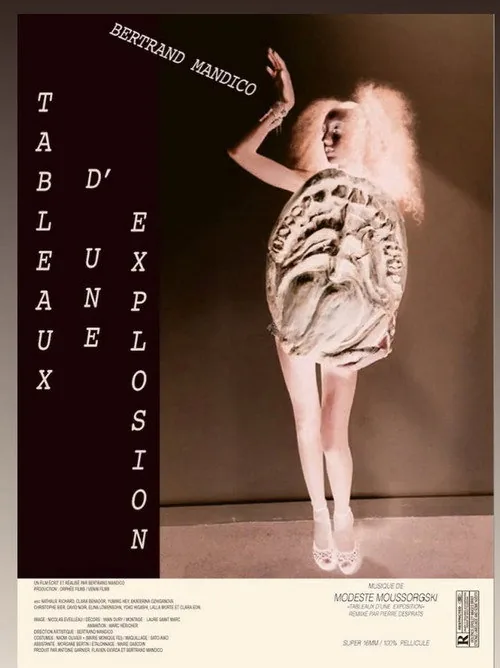
Tableaux d'une explosion
In a post-apocalyptic world, a love triangle involves three models under the spell of a demiurge fashion designer. TABLEAUX D'UNE EXPLOSION is a collision, a reinterpretation of the Petrushka tale set to Mussorgsky's music, 'Pictures at an Exhibition'.
Summary
Set in the ruins of a post-apocalyptic world, Tableaux d’une explosion reimagines the tragic puppet romance of Petrushka as a surreal fashion fable. At its center are three models whose lives and desires are controlled, or at least profoundly shaped, by a visionary fashion designer—a demiurgic figure who treats people as materials in an elaborate artistic creation. Drawn into a volatile love triangle, the models struggle to distinguish genuine feeling from roles imposed upon them by their creator and by the strange society they inhabit. Rather than presenting a conventional survival story, the film appears to use its devastated setting as a stage for an operatic meditation on beauty, desire, and power. The three central figures embody different forms of longing and entrapment, while the designer functions as both artist and authoritarian, blurring the line between inspiration and possession. Their relationships evoke the doomed emotional geometry of Petrushka, with romance, jealousy, and humiliation unfolding inside a world where human beings can seem like puppets in someone else’s spectacle. The film’s structure and mood are closely tied to Modest Mussorgsky’s Pictures at an Exhibition, whose suite provides a musical and conceptual framework for a series of vivid, shifting tableaux. That influence suggests a work driven as much by composition, rhythm, and visual association as by conventional narrative. Fashion, performance, and ruins become interconnected images, turning the aftermath of catastrophe into a gallery of living portraits. At its core, Tableaux d’une explosion explores artistic control, the commodification of bodies, and the fragile boundary between freedom and performance. Its post-apocalyptic landscape is less a backdrop for action than a symbolic space in which civilization’s obsessions with spectacle, beauty, and ownership have been stripped down to their essentials. The result is an enigmatic, highly stylized reinterpretation of a classic tale—part love story, part theatrical experiment, and part critique of the power artists wield over their creations.