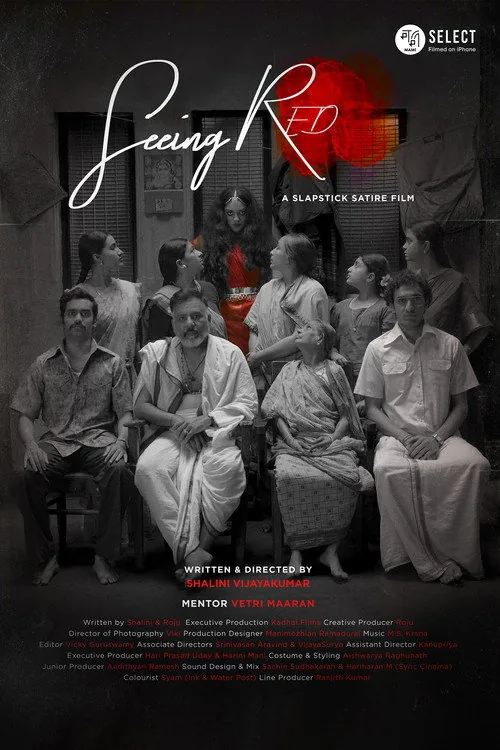
Seeing Red
A quiet morning in a 1980s traditional household in Tamil Nadu spirals into slapstick chaos when three women claim to see a ghost that no one else can. In this sharp satire, the family’s frantic attempts—relying on a stranger’s advice and a ghost hunter—only escalate the confusion, as the lines between possession and protest begin to blur.
Summary
Set in a traditional Tamil household in 1980s Tamil Nadu, Seeing Red begins with an apparently ordinary morning that is thrown into disarray when three women insist that they have seen a ghost. No one else in the family can perceive the spirit, and what might initially be dismissed as fear, imagination, or a shared misunderstanding quickly becomes impossible to contain. As the household members argue over what is happening, their efforts to restore order only turn the situation into increasingly elaborate farce. At the center are the three women whose claims drive the crisis, along with the skeptical and bewildered relatives struggling to decide whether they are witnessing a haunting, a case of possession, or something more grounded in everyday conflict. A stranger offering unexpected advice and a self-styled ghost hunter further complicate matters, bringing their own assumptions and methods into a family already divided by suspicion. Their interventions intensify the confusion rather than resolving it, giving the film its lively, escalating comic energy. Beneath its supernatural premise, Seeing Red is a sharp social satire about who is believed and who is ignored within a family and a wider community. The ghost becomes an ambiguous figure through which the film examines domestic authority, gender expectations, superstition, and the frustrations that can remain hidden behind the appearance of tradition and respectability. Its slapstick humor grows out of the clash between rational explanations and supernatural beliefs, but the comedy also carries a pointed suggestion: what looks like possession may be a form of protest, and what a household calls disorder may be a suppressed demand to be heard. Balancing absurdity with social observation, the film uses a chaotic haunting to question the structures that keep people silent.