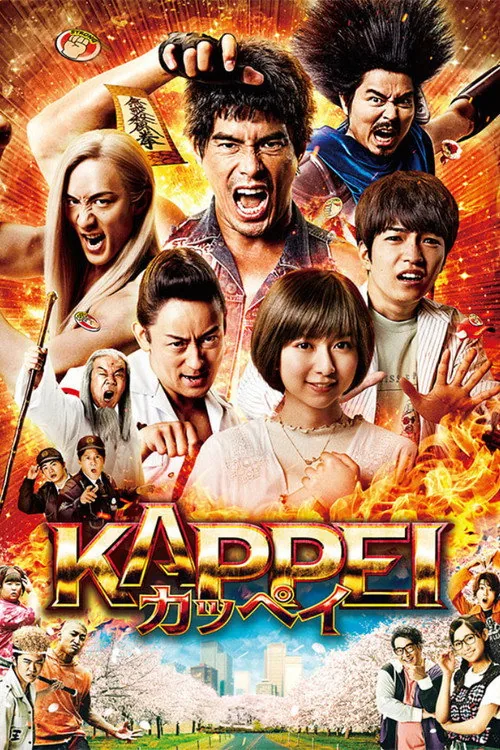
Kappei
In the 16th century, the French astrologer Nostradamus predicted that the world would end in July, 1999. According to him, cataclysms would transform the Earthinto a lawless place where evil would prevail. As the deadline approaches, little Kappei and several other children are isolated on a Japanese island to train in the mystical arts of Mukai Sappuken to save the planet. The problem is that Nostradamus has royally screwed up, so in the spring of 2022, their master sends them to live a “normal” life. Poor Kappei finds himself in Tokyo with shorts that are really too short, the attitude of a manga character, and the psychosocial baggage of a fossil. His quest for justice brings him his first friend, who introduces him to his first love. The apocalypse fighter has not been trained for this at all, and every emotion totally destabilizes him. However, he will have to adapt, as some of his less grounded comrades will soon force a confontation.
Summary
“Kappei” is a wildly comic martial-arts adventure about a hero who has trained for the end of the world that never came. According to Nostradamus’s prophecy, civilization was supposed to collapse in 1999, leaving behind a lawless wasteland ruled by violence. To prepare for that catastrophe, Kappei and several other children were taken to a remote Japanese island, where they spent their lives mastering the mystical fighting style Mukai Sappuken under the stern guidance of their teacher. When it becomes clear that the prophecy was spectacularly wrong, the master finally sends his students into the outside world in 2022. Kappei arrives in Tokyo dressed in comically short shorts and carrying himself like a character from an old-school action manga. He is immensely skilled at combat but almost completely unprepared for ordinary life. Everyday experiences such as making friends, navigating social situations, and understanding romantic feelings prove far more confusing to him than any physical opponent. Kappei’s first real companion is Taro, a kindhearted young man who helps him adjust to modern city life. Through Taro, Kappei meets Natsuki, and his sudden attraction to her becomes an especially destabilizing challenge. His rigid ideas about justice, courage, and duty leave little room for vulnerability or emotional nuance, while his exaggerated behavior makes him as endearing as he is ridiculous. Meanwhile, some of his fellow disciples remain deeply committed to the apocalyptic worldview that shaped them, bringing their own extreme sense of purpose into conflict with Kappei’s attempts to live normally. Adapted from Rensuke Oshikiri’s manga, the film plays its premise as broad, energetic satire, combining cartoonish martial-arts action with fish-out-of-water comedy and an unexpectedly sincere coming-of-age story. Its central joke is that Kappei has prepared for every conceivable disaster except adulthood, but the film also uses that joke to explore how people move beyond inherited beliefs. Beneath the frantic fights and absurd costumes, “Kappei” is about learning that strength is not only the ability to defeat an enemy. Friendship, love, empathy, and the courage to abandon an obsolete mission can be just as difficult—and ultimately just as heroic.