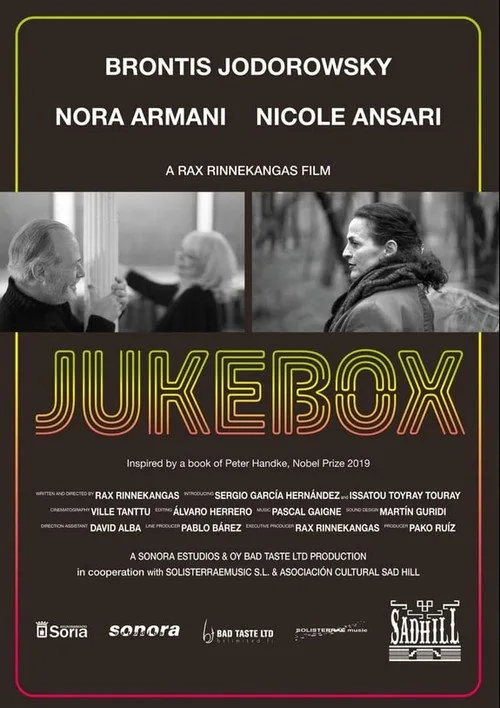
Jukebox
An author travels on Spanish plains to find the magic music device of his youth, the Jukebox. (Inspired by a book of Peter Handke, Nobel prize 2019)
Summary
Jukebox follows an unnamed author who travels across the wide, sun-baked plains of Spain in search of the jukebox that enchanted him during his youth. What begins as a physical quest gradually becomes a journey through memory, imagination, and the elusive relationship between the present and the past. The machine is more than a piece of vintage technology: it represents a lost source of wonder, a private mythology, and the possibility that a song—or a story—can preserve something time has otherwise taken away. The author is the film’s central figure, an observant, inward-looking traveler whose search is shaped as much by recollection as by the landscapes he crosses. Along the way, the people he encounters offer glimpses of different ways of understanding home, desire, art, and the passage of time. Their presence gives the journey a human dimension while also emphasizing the author’s isolation and his tendency to move between lived reality and the imaginative world of literature. Inspired by the work of 2019 Nobel laureate Peter Handke, Jukebox favors atmosphere and reflection over conventional adventure. Its Spanish plains become both a real setting and an interior landscape, where silence, distance, and repetition encourage the protagonist to confront how memory transforms the objects and experiences of childhood. The film explores nostalgia without treating the past as something that can simply be recovered, asking instead why certain songs, places, and objects retain such power long after their original moment has disappeared. At its heart, Jukebox is a meditative story about artistic longing, the search for lost enchantment, and the fragile ways people try to reconnect with who they once were.