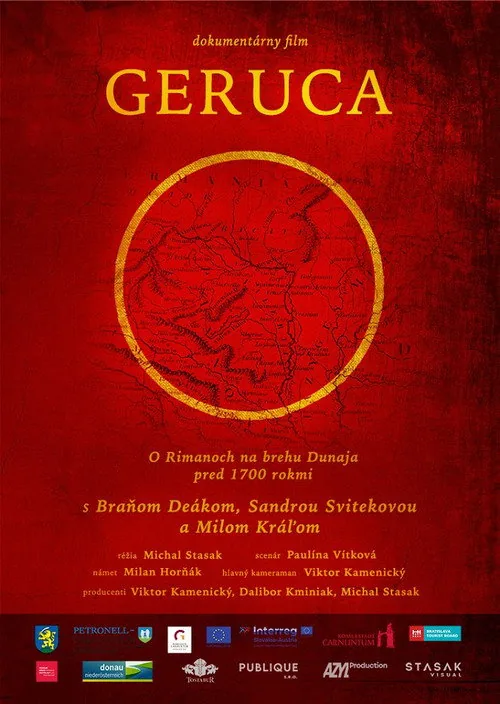
GERUCA
Documentary film about the Romans in Upper Pannonia.
Summary
GERUCA (2022) is a historical documentary about the Roman presence in Upper Pannonia, the frontier region that covered parts of present-day Austria, Hungary, Slovenia, Croatia, and neighboring areas. Rather than centering on a single fictional hero, the film reconstructs the world of the people who lived there: Roman soldiers and administrators, local inhabitants, merchants, craftspeople, and families whose lives unfolded along the empire’s northeastern edge. Through archaeological discoveries, historical research, and views of the surviving landscape, GERUCA explores how Roman rule shaped the region’s settlements, roads, military defenses, economy, customs, and beliefs. The film presents the province not simply as a distant outpost of Rome, but as a meeting place where imperial institutions encountered older local traditions. Everyday details—work, trade, movement, worship, and community life—help bring the ancient population into focus, while experts provide context for interpreting ruins and artifacts. The documentary’s central themes include cultural exchange, the relationship between power and identity, and the lasting traces of a vanished civilization. It also considers how modern archaeology reconstructs the past from fragmentary evidence and how the Roman legacy continues to influence the landscape and historical memory of Central Europe. GERUCA is best understood as an atmospheric, research-driven portrait of a complex borderland, emphasizing the human lives behind the familiar story of the Roman Empire.