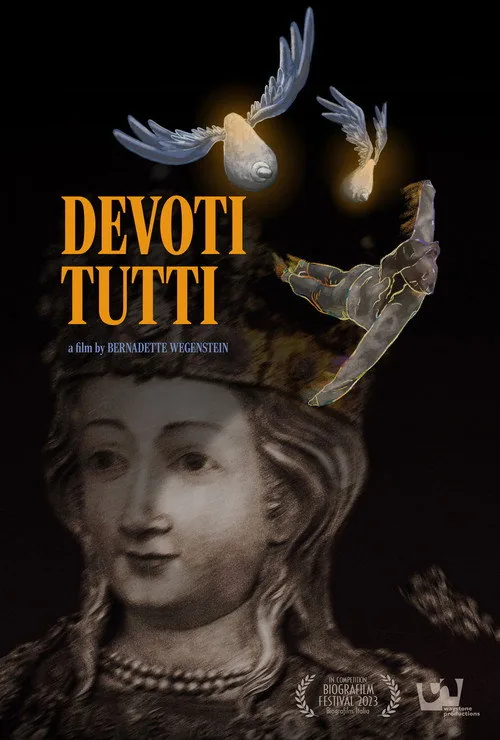
Devoti tutti
A transcendent story about women who struggle to escape the trauma of sexual violence.
Through magical realist animations in the style of baroque chiaroscuro, Devoti Tutti returns to the martyred Saint Agatha of Catania a voice she never had. Alongside a chorus of the citizens of Catania and the stories of real abuse survivors, Devoti Tutti shows how a community’s reverence for its saint masks misogynist realities. In her cell Agatha is kept company by her breasts, which her tormenters severed from her body—a reminder of the violence she suffered, but also of her refusal to submit to a man’s desire. Together with the flying breasts, Agatha escapes from the chamber where she has been held prisoner for two millennia and flies out over the ocean and into her own self-creation.
Summary
Devoti Tutti is an experimental, magical-realist film that reimagines the story of Saint Agatha of Catania, a young woman revered for her martyrdom but traditionally denied a voice of her own. Through richly stylized animation inspired by baroque chiaroscuro, the film places Agatha inside the cell where she has been imprisoned and tortured. There, she is accompanied by the severed breasts taken from her body—strange, animate companions that embody both the violence inflicted upon her and her resistance to being reduced to an object of male desire. As Agatha confronts the story imposed on her, the film expands beyond the saint’s legend to include a chorus of Catania’s citizens and testimonies from real survivors of abuse. Their voices connect an ancient act of misogynistic violence with the realities of the present, questioning how religious devotion and civic identity can coexist with the silencing, objectification, and mistreatment of women. Agatha’s imagined journey becomes an act of reclaiming her body, her narrative, and the right to define herself beyond the martyrdom assigned to her. Rather than offering a conventional historical biography, Devoti Tutti uses symbolism, unsettling humor, and dreamlike imagery to examine the gap between public reverence and private suffering. Its central themes include gendered violence, bodily autonomy, collective memory, and the ways communities preserve sacred myths while overlooking the people those myths can conceal. The result is a provocative portrait of a saint transformed from passive icon into a figure of anger, imagination, and self-creation.