Iván Fischer
Cinematic classical clips and energizing concert pieces featuring up-and-coming artists.
2025-12-02 16:46:04 +0000 UTC→2025-12-02 17:00:00 +0000 UTC(13m)
Cinematic classical clips and energizing concert pieces featuring up-and-coming artists.
Showing1to20of690results
In this splendid concert, exceptional Russian pianists Nikolay Lugansky and Vadim Rudenko join forces in a program for two pianos comprising works of Wolfgang Amadeus Mozart, Maurice Ravel, Anton Arensky, Sergei Rachmaninoff, and Nikolai Kapustin. Both pianists, laureates of the prestigious International Tchaikovsky Competition in 1994, have received international recognition. They perform regularly in a duo. On the program: Mozart's Sonata for two pianos in D major, K. 448/375 A Ravel's La Valse (arr. for two pianos) Arensky's Suite No. 1 for two pianos, Op. 15 and Rachmaninoff's Suite No. 1 (Fantasy) for two pianos, Op. 5. As an encore, the duo performs ‘Romance' from Rachmaninoff's Suite No. 2 for two pianos, Op. 17, followed by ‘Overture' from Nikolai Kapustin's Sinfonietta, Op. 49. This performance was recorded at the Tchaikovsky Concert Hall in Moscow, Russia, on November 25, 2021.
Barbara Hannigan conducts the Mahler Chamber Orchestra in a concert recorded at the Lucerne Festival of 2014. There are pianists who also conduct, and concert masters who lead their orchestra from the violin desk, but a star soprano who coordinates an ensemble while at the same time negotiating the trickiest coloratura singing is something entirely new! This concert opens with the Overture from Rossini's La scala di seta, followed by three concert arias by Mozart: Vado, ma dove? O Dei!, K. 583, Un moto di gioia, K. 579 and Misera, dove son? K. 369. After renditions of György Ligeti's Concert Românesc and Mysteries of the Macabre, the concert closes with Fauré's Pelléas et Mélisande, Op. 80, a suite derived from incidental music.
Belgian conductor Jos van Immerseel leads Anima Eterna Brugge in a concert program dedicated to American composer George Gershwin. The program opens with Gershwin's symphonic suite Catfish Row (arr. Steven D. Bowen) which is based upon music from his famous opera Porgy and Bess (1935). This is followed by the well-known tone poem An American in Paris (1928). After, soprano Claron McFadden joins the orchestra, presenting a selection of Gershwin's classic jazz songs, including ‘The man I love' (1924-27), ‘I got rhythm' (1930), and ‘By Strauss' (1936). She also performs ‘My man's gone now' and ‘Summertime' from Porgy and Bess. The concert ends with Gershwin's celebrated Rhapsody in Blue, with Bart Van Caenegem as featured pianist. This performance was recorded at Concertgebouw Brugge, Belgium, on March 3, 2017.
Young Venezuelan conductor Glass Marcano is a rising star. Having played in various local youth and symphony orchestras as a violinist, her first experience conducting an ensemble followed in 2012. In September 2020, she won the Orchestra Prize at La Maestra Competition – the first orchestra direction contest for women – held in Paris. In this concert, recorded at Opéra de Tours in February 2021, Marcano leads the Orchestre Symphonique Région Centre-Val de Loire/Tours in performances of two Romantic masterpieces. The program opens with Ludwig van Beethoven's Violin Concerto in D major, Op. 61, featuring Stéphanie-Marie Degand as the soloist. This piece is one of the most important works in its genre. The program concludes with Georges Bizet's 1855 Symphony in C major, written when the composer was only 17 years old.
Les Dissonances is a collective of artists founded by violinist David Grimal in 2004. The conductorless ensemble consists of musicians from the most prestigious European orchestras, international soloists, and young talents. In this performance, Les Dissonances present Johannes Brahms's Symphony No. 2 in D major, Op. 73. Whereas it took the composer over a decade to complete his first symphony, he penned his Symphony No. 2 in just a few months, during his summer sojourn in the restful Austrian village of Pörtschach in 1877. Nicknamed his ‘Pastoral' symphony, the work is arguably the most sunny and optimistic of Brahms's four symphonies. Lyrical in character, it features joyful melodies. This performance was recorded at Philharmonie de Paris, France, in 2015.
In this splendid concert, exceptional Russian pianists Nikolay Lugansky and Vadim Rudenko join forces in a program for two pianos comprising works of Wolfgang Amadeus Mozart, Maurice Ravel, Anton Arensky, Sergei Rachmaninoff, and Nikolai Kapustin. Both pianists, laureates of the prestigious International Tchaikovsky Competition in 1994, have received international recognition. They perform regularly in a duo. On the program: Mozart's Sonata for two pianos in D major, K. 448/375 A Ravel's La Valse (arr. for two pianos) Arensky's Suite No. 1 for two pianos, Op. 15 and Rachmaninoff's Suite No. 1 (Fantasy) for two pianos, Op. 5. As an encore, the duo performs ‘Romance' from Rachmaninoff's Suite No. 2 for two pianos, Op. 17, followed by ‘Overture' from Nikolai Kapustin's Sinfonietta, Op. 49. This performance was recorded at the Tchaikovsky Concert Hall in Moscow, Russia, on November 25, 2021.
The Mariinsky Ballet performs 'Anna Karenina', a sweeping two-act ballet choreographed by Alexei Ratmansky. The ballet is based on Lev Tolstoy's 1877 novel that tells the tragic story of the married socialite Anna Karenina and her affair with cavalry officer Count Vronsky. The ballet opens where the novel ends: tormented by despair and loneliness, Anna throws herself under a train, whereupon Count Vronsky discovers his lover's lifeless body. Ratmansky's choreography is set to Rodion Shchedrin's music, which is performed by the Mariinsky Orchestra under the baton of Valery Gergiev. Among the dancers are Ulyana Lopatkina, Victor Baranov, Andrei Yermakov, and Svetlana Ivanova. This performance was recorded at the Mariinsky Theatre in St. Petersburg, Russia, in March 2014.
Cinematic classical clips and energizing concert pieces featuring up-and-coming artists.
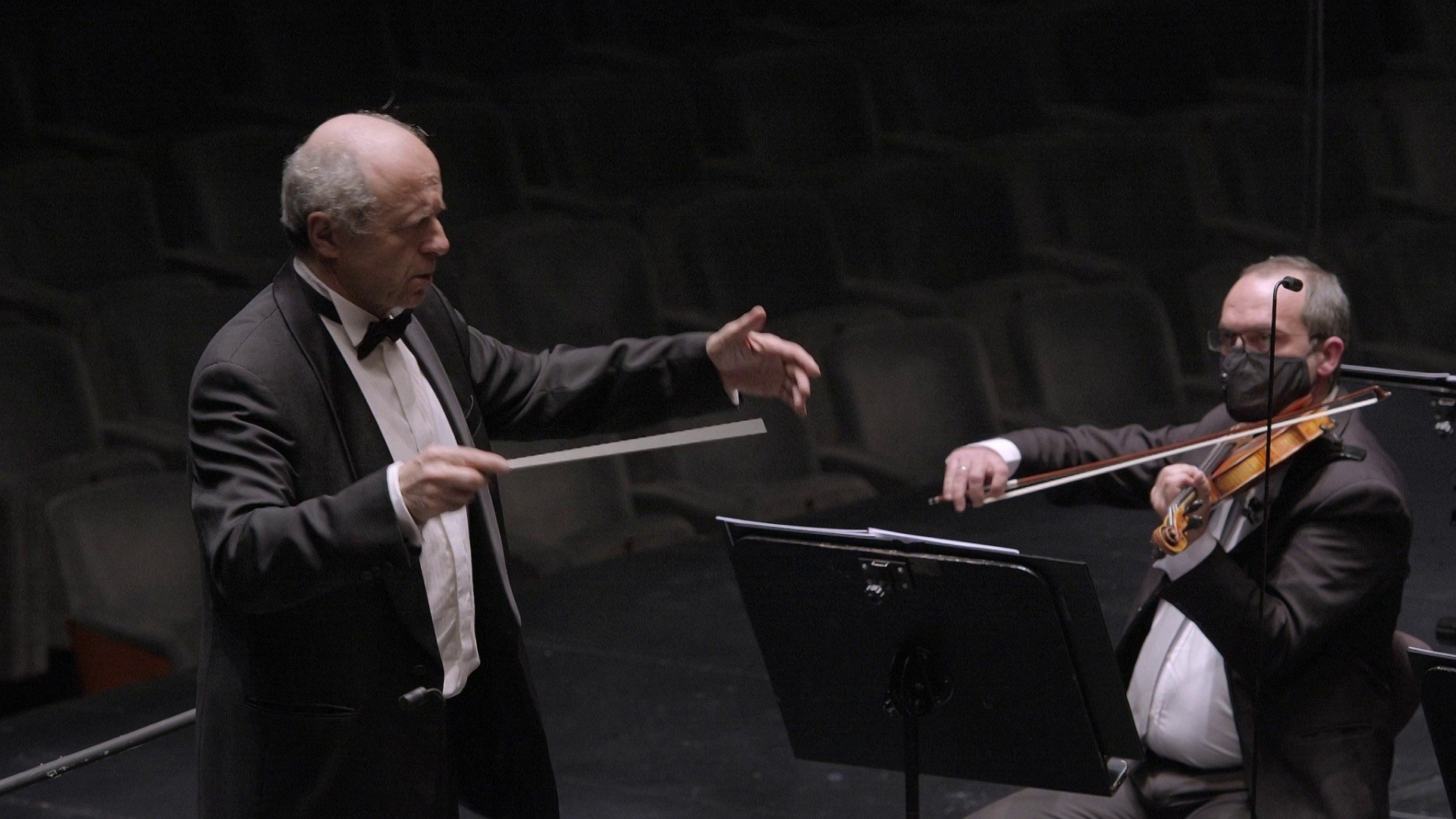
Maestro Iván Fischer leads the Orchestra del Maggio Musicale Fiorentino in a remarkable concert program of works by Wolfgang Amadeus Mozart and Antonín Dvořák. Mozart's Symphony No. 34 in C major, K. 338 opens the program. Completed in the summer of 1780, this was the last symphony Mozart wrote in Salzburg, where he worked as a court musician. The three-movement symphony features two vibrant outer movements with fanfares and rousing themes, while the quieter second movement is scored for strings alone, deviating from the typical four-movement structure of the time. Next on the program is Dvořák's Symphony No. 7 in D minor, Op. 70, completed in March 1885 and premiered one month later in London conducted by the composer himself. With its dramatic and dark style, this symphony stands in stark contrast to the predominantly optimistic tone of Dvořák's broader oeuvre. This performance was recorded at Teatro del Maggio Musicale Fiorentino in Florence, Italy, on January 29, 2021.
Les Dissonances is a collective of artists founded by violinist David Grimal in 2004. The conductorless ensemble consists of musicians from the most prestigious European orchestras, international soloists, and young talents. In this performance, Les Dissonances' string quartet – consisting of David Grimal (violin), Hans Peter Hofmann (violin), David Gaillard (viola), and Xavier Phillips (cello) – performs Franz Schubert's String Quartet No. 15 in G major, D. 887, Op. 161. Schubert composed this work, his final string quartet, in a mere ten days in June 1826. However, this highly original piece, characterized by its restless shifts between major and minor, was not published until after Schubert's death in 1851. This performance was recorded at Cité de la Musique in Paris, France, in 2014.
Les Dissonances is a collective of artists founded by violinist David Grimal in 2004. The conductorless ensemble consists of musicians from the most prestigious European orchestras, international soloists, and young talents. In this performance, Les Dissonances perform Pyotr Ilyich Tchaikovsky's Symphony No. 4 in F minor, Op. 36. The composer wrote the symphony between 1877 and 1878, and dedicated it to Nadezhda von Meck – an exceptionally wealthy widow and great admirer of Tchaikovsky's music, whom the composer described as ‘my best friend'. Tchaikovsky explained in his letters that the symphony is characterization of the nature of fate. The work opens with a powerful motif in the horns and bassoons representing fate. The second movement expresses melancholy, whereas the third presents ‘fleeting images that pass through the imagination when one has begun to drink a little wine'. Although the ‘fate' motif reappears toward the end of the final movement, the movement has a festive character. This performance was recorded at La Cité de la musique in Paris in 2016.
Antoni Wit conducts the Warsaw Philharmonic Orchestra in performances of Chopin's Piano Concertos No. 1, Op. 11 and No. 2, Op. 21. Soloists are Nikolai Demidenko and Evgeny Kissin. After performing the first concerto, Demidenko encores with Chopin's Mazurka Op. 17/4. Kissin closes the concert with Chopin's Etude Op. 10/12 and the Waltz in E minor, Op. post. This concert was part of the celebration of Chopin's 200th anniversary in 2010. Chopin composed the second concerto one year before the Concerto No. 1 and completed both works at the age of 20, before leaving his home country Poland and moving to Paris.
Andris Nelsons, together with his then-wife, the great soprano Kristine Opolais and the Gewandhausorchester Leipzig present a program dedicated to Antonin Dvořák, singing the melodies that the composer hid in all layers of his music with tender, warm, soft colors. Nelsons' tempos remain calm and relaxed, allowing the omnipresent beauty of Dvořák's music to unfold and flood the Gewandhaus. The program opens with Othello, a Concert Overture for Orchestra, Op. 93. Opolais performs “Song to the Moon” from Rusalka, “Songs my Mother Taught Me” from Gypsy Songs, Op. 55/4. This is followed by the Polonaise and 'O, marno, marno to je' from Rusalka and 'Dobrá! Já mu je dám!... Jak je mi?' from Smetana's opera Dalibor. The concert closes with a performance of Dvořák's Symphony no. 9 in E Minor, Op. 95 (“From the New World”). Recorded at the Gewandhaus, Leipzig in May 2017.
Swiss conductor Philippe Jordan and the Orchestre de l'Opéra national de Paris recorded all of Ludwig van Beethoven's symphonies in 2014-2015. In this program, maestro Jordan presents Beethoven's final symphony: Symphony No. 9 in D minor, Op. 125. He conducts the Orchestre and Choeurs de l'Opéra national de Paris and four vocal soloists Ricarda Merbeth (soprano), Daniela Sindram (mezzosoprano), Robert Dean Smith (tenor), and Günther Groissböck (bass). Beethoven composed his last Symphony when his hearing had all but gone, between 1822 and 1824. Symphony No. 9 is the longest and most ambitious of Beethoven's symphonies. Most striking is the piece's finale movement, which includes a choir and four vocal soloists singing a setting of Friedrich Schiller's poem ‘An die Freude' (Ode to Joy). This performance was recorded at Opéra Bastille in Paris, France, in 2015.
Iván Fischer conducts the Budapest Festival Orchestra in a concert recorded at the Béla Bartók National Concert Hall in Budapest, Hungary in 2015. The concert opens with Sergei Prokofiev's Overture on Hebrew Themes, Op. 34. After this, Thomas Zehetmair stars as solo violinist in Prokofiev Violin Concerto No. 2, Op. 63. The second part of the concert is features music by Igor Stravinsky. On the program is music composed for the ballet 'Jeu de cartes' (1937) and the Firebird Suite, No. 2 (1919). 'Jeu de cartes' is one of Stravinsky's neo-classical works and consists of three parts ('deals'). The Firebird Suite, No. 2 is based on the music from the ballet of the same name, which was written for Sergei Diaghilev's Ballets Russes and premiered in Paris in 1910.
This stunning performance of theatrical ice dancing brings viewers into the enchanting world of Tchaikovsky's magnificent holiday classic, The Nutcracker On Ice, performed by the internationally renowned Imperial Ice Stars, and including former champion figure skaters, Vadim Yarkov and Olga Sharutenko. This very special performance and soundtrack was performed by the Manchester Symphony Orchestra, conducted by Tim A. Duncan, and filmed live in Cape Town, South Africa in 2011.
French lutenist Thomas Dunford performs various works for lute by J. S. Bach in this intimate chamber music concert, recorded at Concertgebouw Brugge, Belgium, in 2017. On the program are Suite for lute in G minor, BWV 995 Suite for solo cello in G major (arr. for lute), BWV 1007 and Chaconne from Partita for solo violin in D minor (arr. lute), BWV 1004. Paris-born lutenist Thomas Dunford (*1988) discovered the lute at the age of nine. He studied at the Conservatory of Paris and the Schola Cantorum in Basel, and participated in masterclasses with lutenists such as Rolf Lislevand and Julian Bream. He has made various solo and ensemble appearances at Europe's most prestigious festivals.
Sergei Prokofiev based his ballet ‘Romeo and Juliet' on William Shakespeare's famous play of the same name, telling the story of two young lovers from the feuding families Montague and Capulet. Acclaimed French choreographer Jean-Christophe Maillot created a distinctive choreography of the ballet in 1996, which has been performed to great success the world over. In his production, Maillot interprets Romeo and Juliet not as a social conflict or clan warfare governed by a strict code of honor, but as a tale of accidental tragedy that leads to the death of children more concerned with the path of love than that of hatred. This 2002 interpretation is performed by the dancers of Les Ballets de Monte Carlo. Chris Roelandt and Bernice Coppieters star in the title roles.
This stunning performance of theatrical ice dancing brings viewers into the enchanting world of Tchaikovsky's magnificent holiday classic, The Nutcracker On Ice, performed by the internationally renowned Imperial Ice Stars, and including former champion figure skaters, Vadim Yarkov and Olga Sharutenko. This very special performance and soundtrack was performed by the Manchester Symphony Orchestra, conducted by Tim A. Duncan, and filmed live in Cape Town, South Africa in 2011.
At the age of seven, Argentine pianist Martha Argerich made her debut with Ludwig van Beethoven's Piano Concerto No. 1 in C major, Op. 15, a piece that would accompany her throughout her career. The celebrated pianist performs this signature piece at the Lucerne Festival with the Lucerne Festival Orchestra under the baton of Swedish conductor Herbert Blomstedt, who makes his festival debut with the orchestra. Beethoven's Symphony No. 2 in D major, Op. 36, is also on the program. This performance was recorded at the Lucerne Culture and Congress Center (KKL), Switzerland, in August 2020.
Showing1to20of690results


