Schedule for Stingray Classica

Quatuor Ebène

Quatuor Ebène

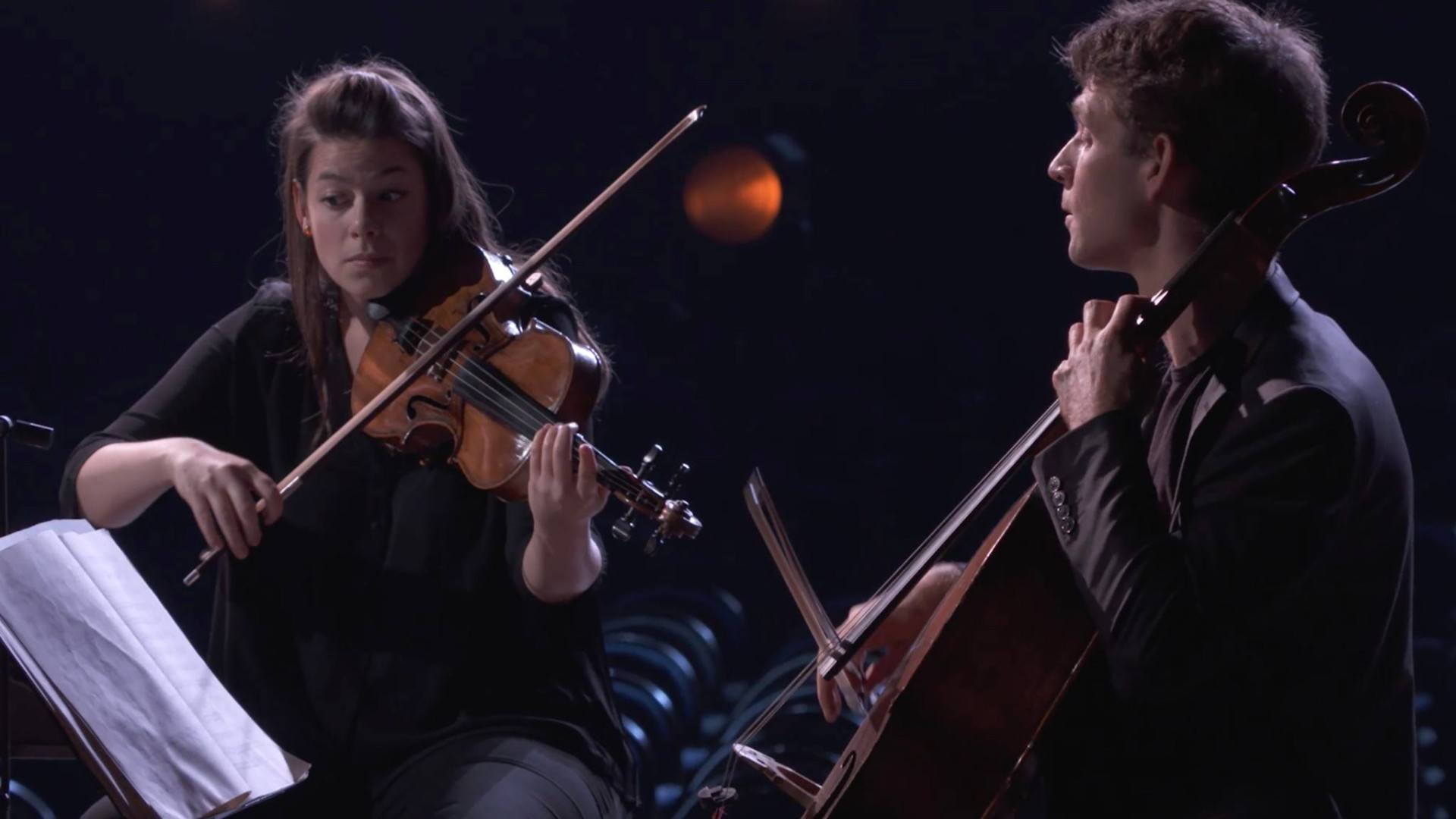
Renowned French string quartet Quatuor Ébène marked the 250th birth anniversary of Ludwig van Beethoven (1770-1827) with a remarkable project: recording all of the great composer's sixteen string quartets. For five years, violinists Pierre Colombet and Gabriel Le Magadure, violist Marie Chilemme, and cellist Raphaël Merlin immersed themselves in Beethoven's 650 pages of sheet music. Their efforts culminated in the performance of the composer's complete repertoire for string quartet, which covers three decades of Beethoven's musical creativity, during six impressive concerts at Philharmonie de Paris in the autumn of 2020. Quatuor Ébène explored every facet of Beethoven's string quartet repertoire: from the youthful Opus 18 string quartets to the Razumovsky, Harp, and Serioso quartets (Opus 59, 74, and 95) from his middle period, and finally, the depth of his late quartets (Opus 127 to 135). This program features Quatuor Ébène performing Beethoven's String Quartet No. 3 in D major, Op. 18 No. 3 String Quartet No. 11 in F minor, Op. 95, “Quartetto Serioso” and String Quartet No. 8 in E minor, Op. 59, No. 2, "Razumovsky". This concert performance was recorded at Philharmonie de Paris on November 23, 2020.

2025-12-17 05:00:00 +0000 UTC2025-12-17 06:45:00 +0000 UTC (1h45m)
Previous Next
Daniel Harding, Orchestra del Maggio Musicale Fiorentino, Coro del Maggio Musicale Fiorentino & Christiane Karg

Daniel Harding, Orchestra del Maggio Musicale Fiorentino, Coro del Maggio Musicale Fiorentino & Christiane Karg

Daniel Harding leads the Orchestra and Choir of the Maggio Musicale Fiorentino and four vocal soloists in a magnificent performance of Wolfgang Amadeus Mozart's Requiem in D minor, K. 626. The soloists are soprano Christiane Karg, mezzosoprano Sara Mingardo, tenor Matthew Swensen, and bass Gianluca Buratto. The Austrian Count Walsegg commissioned Mozart to compose a Requiem in July 1791 to commemorate his late wife, Anna. At the time, Mozart was busy working on his operas La clemenza di Tito and The Magic Flute. By the time he started on the Requiem, in the fall of that same year, his health was seriously declining. Mozart passed away in December 1791, leaving the Requiem uncompleted. His pupil Franz Xaver Süssmayr completed Mozart's swan song in the form known today, based on Mozart's sketches and possibly verbal instructions. This performance was recorded at Teatro del Maggio Musicale Fiorentino in Florence, Italy, in 2021.

2025-12-27 09:45:00 +0000 UTC2025-12-27 11:00:00 +0000 UTC (1h15m)
Philippe Jordan & Orchestre de l'Opéra national de Paris

Philippe Jordan & Orchestre de l'Opéra national de Paris

Swiss conductor Philippe Jordan and the Orchestre de l'Opéra national de Paris recorded all of Ludwig van Beethoven's symphonies in 2014-2015. In this program, Jordan conducts Beethoven's Symphony No. 8 in F major, Op. 93. Beethoven wrote the work in 1812 upon completion of his Symphony No. 7. The composer conducted the February 27, 1814 première at a concert in Vienna that also included a reprise performance of his Symphony No. 7 and his 15-minute orchestral piece Wellington's Victory, Op. 91. The shortest of Beethoven's nine symphonies, Symphony No. 8 lacks a truly slow movement. Instead it has a second movement, Allegretto scherzando, that features a steady ‘ticking' rhythm maintained by the woodwinds throughout the movement. This is thought to be an imitation of the Andante movement of Joseph Haydn's ‘Clock' Symphony. Jordan's performance was recorded at Opéra Bastille in Paris, France, in 2015.

2025-12-27 09:00:00 +0000 UTC2025-12-27 09:45:00 +0000 UTC (45m)
Philippe Herreweghe & Collegium Vocale Gent

Philippe Herreweghe & Collegium Vocale Gent

The Collegium Vocale Gent has built its reputation as one of the world's most prestigious choirs. Founded by conductor Philippe Herreweghe, their lively, musical approach strives for an authentic sound. This concert was recorded on December 23, 2015, at the Church of Saint-Roch in Paris. Owing to J. S. Bach's function as the Thomaskantor, the leading cantorate of Protestant Germany at the time, he composed many cantatas for the Lutheran liturgy. These Christmas cantatas are an invitation to reflect on the nature of Christmas. The orchestration evokes feelings of splendor while the counterpoint also carries on a festive mood. The wind instruments act as glorious messengers of joy and the soloists proclaim that the glory brings light. This unique program, consisting of the four cantatas BWV 40, 62 , 63 and 91, offers an elegant and very delicate interpretation of these works. Under the baton of Philippe Herreweghe, the Collegium Vocale delivers an interpretation free of exaggeration or vanity yet full of humility. A glorious concert in the spirit of Christmas.

2025-12-27 07:15:00 +0000 UTC2025-12-27 09:00:00 +0000 UTC (1h45m)
Les Dissonances & David Grimal

Les Dissonances & David Grimal

Les Dissonances is a collective of artists founded by violinist David Grimal in 2004. The conductorless ensemble consists of musicians from the most prestigious European orchestras, international soloists, and young talents. In this performance, Les Dissonances present Johannes Brahms's Symphony No. 2 in D major, Op. 73. Whereas it took the composer over a decade to complete his first symphony, he penned his Symphony No. 2 in just a few months, during his summer sojourn in the restful Austrian village of Pörtschach in 1877. Nicknamed his ‘Pastoral' symphony, the work is arguably the most sunny and optimistic of Brahms's four symphonies. Lyrical in character, it features joyful melodies. This performance was recorded at Philharmonie de Paris, France, in 2015.

2025-12-27 06:15:00 +0000 UTC2025-12-27 07:15:00 +0000 UTC (1h)
Matthias Goerne, Vilde Frang, Nicolas Altstaedt & Stathis Karapanos

Matthias Goerne, Vilde Frang, Nicolas Altstaedt & Stathis Karapanos

Baritone Matthias Goerne teams up with violinist Vilde Frang, cellist Nicolas Altstaedt, flutist Stathis Karapanos, and harpsichordist Michaela Hasselt in this program dedicated to the music of J. S. Bach. They perform baritone arias from Bach's most beautiful cantatas, as well as solo pieces and duets. On the program are Sonata No. 3 in C major for violin solo, BWV 1005 arias ‘Hier, in meines Vaters Stätte', BWV 32 and ‘Die Welt mit allen Königreichen', BWV 59 Suite No. 5 in C minor for cello solo, BWV 1011 ‘Wenn Trost und Hülf ermangeln muß', BWV 117 ‘Ja, ja, ich halte Jesum fest', BWV 157 Invention No. 7 in E minor, BWV 778 Invention in A major, BWV 783 and ‘Welt ade, ich bin dein müde', BWV 158. This performance was recorded at St. Mary's Church in Wittenberg, Germany.

2025-12-27 05:00:00 +0000 UTC2025-12-27 06:15:00 +0000 UTC (1h15m)
Beatrice Rana, Gianandrea Noseda & London Symphony Orchestra

Beatrice Rana, Gianandrea Noseda & London Symphony Orchestra

Italian conductor Gianandrea Noseda leads the London Symphony Orchestra (LSO) in a performance of Ludwig van Beethoven's Piano Concerto No. 5 in E-flat major, Op. 73, famously known as the ‘Emperor' Concerto. Italian pianist Beatrice Rana features as the soloist here. The New York Times describes her as ‘one of the most insightful and prodigiously gifted artists of the new generation'. Beethoven's Fifth Piano Concerto opens with a grand, majestic chord followed by a brilliant flourish from the piano, setting the tone for one of the most celebrated works in the piano repertoire. Composed between 1809 and 1811, it reflects Beethoven's heroic spirit during a turbulent period in European history and is admired for its boldness, lyricism, and virtuosic demands. This concert was recorded at London's Barbican Hall, UK, on February 2, 2022.

2025-12-27 04:00:00 +0000 UTC2025-12-27 05:00:00 +0000 UTC (1h)
Ivan Fischer & Budapest Festival Orchestra

Ivan Fischer & Budapest Festival Orchestra

Iván Fischer leads his Budapest Festival Orchestra in an exciting concert program consisting of works by J. S. Bach, Béla Bartók, and Johannes Brahms. The program opens with Bach's Brandenburg Concerto No. 3 in G major, BWV 1048. This is followed by one of Bartók's best-known pieces: Music for strings, percussion and celesta. Remarkable is the work's instrumentation: Bartók divided the strings into two groups that are placed on opposite sides of the stage, to create antiphonal effects. The program ends with Brahms's Symphony No. 3 in F major, Op. 90. This performance was recorded at the Béla Bartók National Concert Hall in Budapest, Hungary, on December 4, 2017.

2025-12-26 21:15:00 +0000 UTC2025-12-26 23:15:00 +0000 UTC (2h)
Ballet of the Mariinsky Theatre

Ballet of the Mariinsky Theatre

'La Bayadère' is a three-act ballet by the French choreographer Marius Petipa. Set in 19th-century India, 'La Bayadère' tells the sad love story of the noble warrior Solor and his Nikia, a temple dancer or 'bayadère', who is poisoned by her rival, Gamzatti. The ballet features one of the most celebrated scenes of classical ballet, namely 'The Kingdom of the Shades'. In this iconic scene, Solor dreams, under the influence of opium, of reuniting with his beloved Nikia. This production of the ballet features the revised choreography by Vladimir Ponomarev and Vakhtang Chabukiani (1941), and includes dances by Konstantin Sergeyev and Nikolai Zubkovsky. The ballet's music, composed by Ludwig Minkus, is performed by the Mariinsky Orchestra under the direction of Boris Gruzin. Among the performers are Viktoria Tereshkina, Anastasia Matvienko, Vladimir Shklyarov, and Vladimir Ponomarev. This performance was recorded at the Mariinsky Theatre in St. Petersburg, Russia, in July 2014.

2025-12-26 18:30:00 +0000 UTC2025-12-26 21:15:00 +0000 UTC (2h45m)
Iván Fischer & Orchestra del Maggio Musicale Fiorentino

Iván Fischer & Orchestra del Maggio Musicale Fiorentino

Maestro Iván Fischer leads the Orchestra del Maggio Musicale Fiorentino in a remarkable concert program of works by Wolfgang Amadeus Mozart and Antonín Dvořák. Mozart's Symphony No. 34 in C major, K. 338 opens the program. Completed in the summer of 1780, this was the last symphony Mozart wrote in Salzburg, where he worked as a court musician. The three-movement symphony features two vibrant outer movements with fanfares and rousing themes, while the quieter second movement is scored for strings alone, deviating from the typical four-movement structure of the time. Next on the program is Dvořák's Symphony No. 7 in D minor, Op. 70, completed in March 1885 and premiered one month later in London conducted by the composer himself. With its dramatic and dark style, this symphony stands in stark contrast to the predominantly optimistic tone of Dvořák's broader oeuvre. This performance was recorded at Teatro del Maggio Musicale Fiorentino in Florence, Italy, on January 29, 2021.

2025-12-26 17:00:00 +0000 UTC2025-12-26 18:19:54 +0000 UTC (1h19m)
Les Arts Florissants & Paul Agnew

Les Arts Florissants & Paul Agnew

Italian composer Claudio Monteverdi (1567-1643) composed nine books of madrigals in half a century, which helped transform the genre from the polyphonic, a cappella madrigals of the late Renaissance to the ‘concertato' madrigals of the early Baroque, shifting the style's focus to the ability of music to express emotions contained in a text. In 2011, British tenor Paul Agnew and renowned Baroque ensemble Les Arts Florissants started recording eight books of Monteverdi's madrigals. In this program, Agnew leads Les Arts Florissants in the madrigals of Book I. Published on New Year's day of 1587, Book I consist of seventeen madrigals for five voices. This performance was recorded at the Cité de la musique in Paris, France, in 2011.

2025-12-26 16:00:00 +0000 UTC2025-12-26 17:00:00 +0000 UTC (1h)
Vadim Yarkov

Vadim Yarkov

This stunning performance of theatrical ice dancing brings viewers into the enchanting world of Tchaikovsky's magnificent holiday classic, The Nutcracker On Ice, performed by the internationally renowned Imperial Ice Stars, and including former champion figure skaters, Vadim Yarkov and Olga Sharutenko. This very special performance and soundtrack was performed by the Manchester Symphony Orchestra, conducted by Tim A. Duncan, and filmed live in Cape Town, South Africa in 2011.

2025-12-26 09:00:00 +0000 UTC2025-12-26 11:00:00 +0000 UTC (2h)
Roberto Abbado, Filarmonica Arturo Toscanini, Coro del Teatro Regio di Parma & Eleonora Buratto

Roberto Abbado, Filarmonica Arturo Toscanini, Coro del Teatro Regio di Parma & Eleonora Buratto

Roberto Abbado conducts the Filarmonica Arturo Toscanini, the Coro del Teatro Regio di Parma, and four vocal soloists in an outstanding performance of Giuseppe Verdi's Messa da Requiem, recorded at the Parco Ducale di Parma, Italy as part of Festival Verdi 2020. The soloists are soprano Eleonora Buratto, mezzosoprano Anita Rachvelishvili, tenor Giorgio Berrugi, and bass Roberto Tagliavini. When his fellow composer Gioachino Rossini died in 1868, Verdi proposed to compose a ‘Messa per Rossini' in his honor, to be written by himself and several other Italian composers. Verdi wrote the concluding movement, ‘Libera me'. When the premiere was cancelled, the project lay dormant. When Italian poet Alessandro Manzoni passed away a few years later, Verdi revisited his plan to compose a requiem – this time in honor of the poet he so greatly admired. As an opera composer, Verdi knew better than anyone how to infuse the work with drama, as is evident in the revised version of his ‘Libera me'. The famous, powerful ‘Dies Irae' especially stands out, depicting the horrors of the Last Judgement.

2025-12-26 07:00:00 +0000 UTC2025-12-26 08:48:13 +0000 UTC (1h48m)
Quatuor Ebène

Quatuor Ebène

Renowned French string quartet Quatuor Ébène marked the 250th birth anniversary of Ludwig van Beethoven (1770-1827) with a remarkable project: recording all of the great composer's sixteen string quartets. For five years, violinists Pierre Colombet and Gabriel Le Magadure, violist Marie Chilemme, and cellist Raphaël Merlin immersed themselves in Beethoven's 650 pages of sheet music. Their efforts culminated in the performance of the composer's complete repertoire for string quartet, which covers three decades of Beethoven's musical creativity, during six impressive concerts at Philharmonie de Paris in the autumn of 2020. Quatuor Ébène explored every facet of Beethoven's string quartet repertoire: from the youthful Opus 18 string quartets to the Razumovsky, Harp, and Serioso quartets (Opus 59, 74, and 95) from his middle period, and finally, the depth of his late quartets (Opus 127 to 135). This program features Quatuor Ébène performing Beethoven's String Quartet No. 2 in G major, Op. 18, No. 2 String Quartet No. 16 in F major, Op. 135 and String Quartet No. 14 in C-sharp minor, Op. 131. This concert was recorded at Philharmonie de Paris on December 16, 2020.

2025-12-26 05:00:00 +0000 UTC2025-12-26 07:00:00 +0000 UTC (2h)
David Grimal & Les Dissonances

David Grimal & Les Dissonances

Les Dissonances is a collective of artists founded by violinist David Grimal in 2004. The conductorless ensemble consists of musicians from the most prestigious European orchestras, international soloists, and young talents. In this performance, Les Dissonances perform Johannes Brahms' String Sextet No. 1 in B-flat major, Op. 18. The work is scored for two violins, two violas, and two cellos. Brahms wrote his only two string sextets at the very beginning of his career. String Sextet No. 1 was written in 1860. Brahms was one of the first to compose for this ensemble, blazing a trail for Antonín Dvořák, Pyotr Ilyich Tchaikovsky, Arnold Schoenberg, and others. This performance was recorded at Opéra de Dijon, France, in 2013.

2025-12-26 04:15:00 +0000 UTC2025-12-26 05:00:00 +0000 UTC (45m)
London Symphony Orchestra, Kirill Karabits & Lucy Crowe

London Symphony Orchestra, Kirill Karabits & Lucy Crowe

Ukrainian conductor Kirill Karabits leads the London Symphony Orchestra in a stunning performance of Gustav Mahler's Symphony No. 4. The soloist is soprano Lucy Crowe. Mahler's Fourth Symphony opens with the sound of sleighbells and melodies of childlike innocence. But between this deceptively playful opening and the serene finale – a child's vision of Heaven – lies a world of profound emotion and beauty. With soprano Lucy Crowe lending her vocal radiance to this extraordinary finale, the symphony's journey to bliss is complete. This performance was recorded at the Barbican Hall in London, UK, on December 8, 2021.

2025-12-25 21:15:00 +0000 UTC2025-12-25 22:30:00 +0000 UTC (1h15m)
Valery Gergiev

Valery Gergiev

This visually stunning production of Nutcracker is a graceful and timeless adventure on a grand scale. From the lovely Waltz of the Flowers to the crystalline beauty of the stunning Snowflake Waltz, each scene is more breathtaking than the last, bringing to life all the well-known and beloved characters with fresh sparkle and compelling originality. It is Christmas Eve and we are brought to a party at which Drosselmeyer gives young Clara a nutcracker doll - beginning a night that includes a magically growing Christmas tree, a midnight battle of toy soldiers at which the Nutcracker defeats the villainous Mouse King and his army of mice, and a headlong pas de deux in which Clara and Hans-Peter meet and celebrate their triumph before being enveloped in a magical snowstorm. Act II whisks the young pair off to the Kingdom of the Sweets, where they are entertained by the Sugar Plum Fairy with her handsome Prince and her glittering court in a series of dazzling dances. Under the direction of Andreas Morell, Valery Gergiev conducts the Mariinsky Orchestra and Choir. Soloists are Mikhail Makarov, lldar Abdrazakov, Anna Markarova, Sergei Skorokhodov, Timur Abdikeyev, Vladislav Sulimasky. This production was recorded at the Mariinsky Theatre in 2012.

2025-12-25 19:00:00 +0000 UTC2025-12-25 21:15:00 +0000 UTC (2h15m)
Gewandhausorchester, Andris Nelsons & Baiba Skride

Gewandhausorchester, Andris Nelsons & Baiba Skride

In May 2019, the new principal conductor of the Gewandhaus, Andris Nelsons, presented Tchaikovsky's Symphony No. 5 with his orchestra in combination with Shostakovich's Violin Concerto No. 1 with outstanding violinist Baiba Skride as the soloist. In this composition, the violin does not allow itself a break, continually tells its dark story and gets into a vicious circle of ostinato Passacaglia bass lines again and again falls into beguilingly beautiful singing. Tchaikovsky initially thought his 'Symphony of Fate' was a failure and believed himself to be at the end of his creative powers. It was probably the composer's nature, plagued by self-doubt, that made it almost impossible for him to develop a self-confident attitude to his own creative power. Between this two works, Skride performs Stravinsky's Elegy for Solo Violin.

2025-12-25 17:00:00 +0000 UTC2025-12-25 19:00:00 +0000 UTC (2h)
Previous Next